Polishing Large Diameter Bare Fibers with KrellTech’s SpecPro™ System
March 30, 2026, 8:45 p.m.
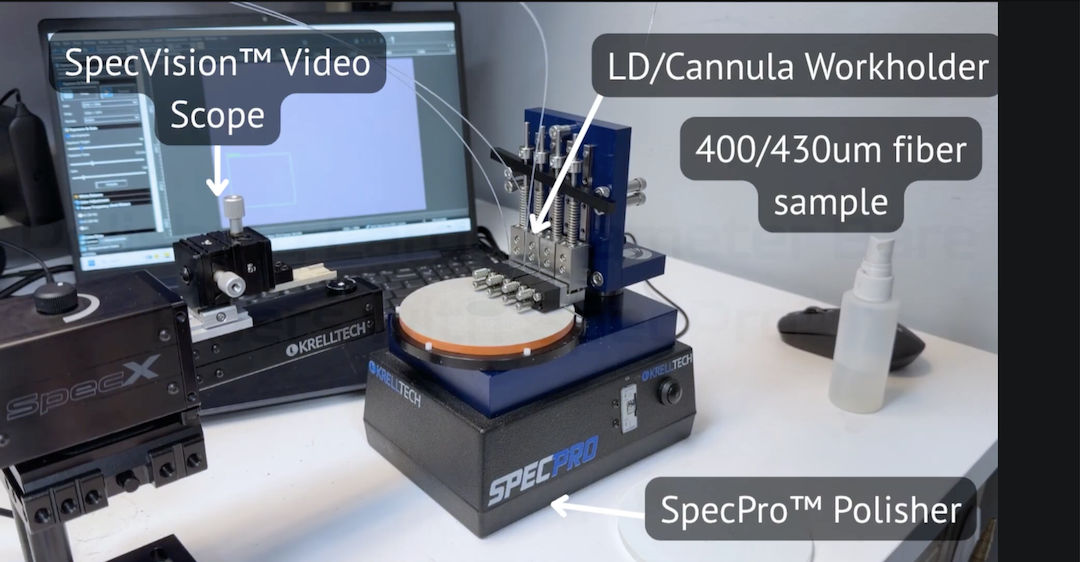
Watch the full video demonstration of polishing large diameter bare fibers with SpecPro™.
Large diameter bare fiber polishing requires a process that can deliver stability, repeatability, and a high-quality endface without introducing unnecessary risk of breakage. In this application, KrellTech’s SpecPro™ Polishing System was used to polish a 400/430 µm fiber sample held in our LD/cannula workholder, with in-line inspection performed throughout the process using the SpecVision™ video scope.
The process begins by installing the fiber into the precision V-groove of the workholder, which helps stabilize the fiber during polishing. A spacer is used to maintain consistent fiber protrusion, helping support repeatable results from one sample to the next. This setup is especially important when working with large diameter fibers, where maintaining control over position and pressure is critical.
For the first polishing step, we used a 30 µm silicon carbide film with a 40D rubber disc for a 30-second dry polish. The rubber disc helps absorb the sharper initial impact of the polishing step while beginning to refine the fiber endface. After this step, the CleanTouch™ Stick is used to remove debris from the surface before inspection.
Once the debris is cleared, the SpecVision™ video scope is used to inspect the fiber surface. Because inspection is in-line, the fiber does not need to be removed from the workholder. This helps save time, reduces handling, and allows the operator to quickly evaluate the polishing progress before moving to the next step.
The second step uses a 9 µm silicon carbide film on a glass disc for another 30-second dry polish. Moving to a glass disc helps ensure a flatter polish and continues refining the surface finish after the initial material removal step. After polishing, the CleanTouch™ Stick is again used to remove debris, and the fiber is inspected with the SpecVision™ video scope. The scope engages directly with the workholder, making it easy to check the surface finish without interrupting the workflow.
The final polishing step uses a 0.3 µm aluminum oxide film on a glass disc in a wet polish process. Only a couple of light sprays of water are needed directly on the film to support the final polish. This last step is designed to improve the final surface finish and prepare the fiber for endface evaluation. After polishing is complete, the fiber is dried and cleaned using SkyBrite™ wipes for final inspection.
One of the advantages of this workcell approach is that polishing and inspection are combined into one system. The operator can move through each polishing stage, inspect results in-line, and make adjustments as needed without removing the fiber from the workholder. This helps improve efficiency while supporting a more controlled process.
Switching polishing films and discs is also straightforward, which makes the system practical for day-to-day production and development work. Multiple discs can be prepared ahead of time when needed, helping maximize throughput and efficiency.
KrellTech’s workholder design also supports process consistency. Independently suspended polishing positions and equalized pressure distribution help minimize fiber breakage, while optically aligned polishing positions help precisely control endface geometry. Together, these features make the SpecPro™ system well suited for large diameter bare fiber applications where process control and inspection are essential.
For this application, the products used included the SpecPro™ Polishing System, LD/cannula workholder, SpecVision™ video scope, CleanTouch™ Stick, and SkyBrite™ wipes. The polishing recipe consisted of a 30 µm silicon carbide film with a 40D rubber disc for 30 seconds dry, followed by a 9 µm silicon carbide film with a glass disc for 30 seconds dry, and a final 0.3 µm aluminum oxide film with a glass disc for a wet polish.
This example highlights how KrellTech’s SpecPro™ platform can support a streamlined polish-and-inspect workflow for large diameter bare fibers, helping users achieve a flat, refined finish with greater confidence and efficiency.